 Wholesale supermarket printers

By printer type, the label printer market is divided into industrial, desktop, and mobile/portable.
The industrial label printer segment is expected to grow strongly because it is used more and more in manufacturing, logistics, and warehousing. They provide reliable label creation in large numbers, can handle many tasks, and run quickly, so they are perfect for constant use in busy companies. Because of high-volume use in manufacturing and logistics, the industrial segment is the largest.
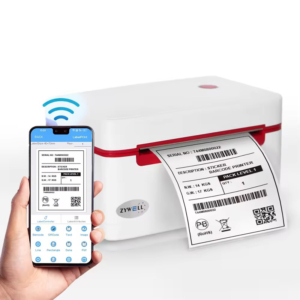
Bluetooth Label Printer
More companies in retail, healthcare, and small businesses are choosing desktop label printers, which is boosting the segment’s growth. Because they are compact, simple to use, and not expensive, they are a good fit for projects handling up to a medium number of labels. Printers are being used now in various areas because companies are looking for devices with better connections and print quality.
Analysis by Technology
Based on technology, the label printer market is subdivided into thermal, direct, inkjet, and laser.
Thermal labels are expected to dominate the market because they are fast, require very little upkeep, and have excellent quality. Thermal printers are most often preferred for barcode and shipping labels in logistics, retail, and healthcare because they are efficient and cost less in high-volume work. Thermal segment has become the main choice because it is economical, fast, and dependable in large-scale labelling for retail and logistics sectors.
More demand for sharp and colorful labels is behind the consistent growth of the inkjet label printer industry. Since labels in the food, beverage, and cosmetics industries often need to be attractive, using inkjet printers allows more flexibility in designing and customizing them for smaller production runs, which also helps in branding the products.
Analysis by End user
Based on end user, the label printer market is divided into manufacturing, warehousing, retail, and transportation & logistics.
Transportation and logistics use a large number of label printers, since they need accurate, sturdy labels for shipping, tracking, and storage. With label printers, things can be identified, updates made in real time, and there is compliance with international logistics standards. Transportation & Logistics is the biggest because precise and secure labelling is crucial for goods tracking along the supply chain.
Because of increased automation and the use of inventory tracking, the warehouse segment is seeing steady growth. Doing stock management is easier using label printers, since they make ordering accurate and storing products efficient. Because e-commerce and fulfilment centers are expanding, there is a greater need for reliable printing solutions in warehouses.